
Tabby Cats
What’s a Tabby Cat??
“Hi - This is Willowe - Willowe with an “e”. I’m a tabby cat. My owner, Diana, had no idea what that meant, so I told her all about tabby cats. This is my story.”
I’m Diana. I’m going to take over for Willowe here, but she’s sitting beside me.
What’s the most common question people ask about Tabbies? Is “tabby cat” a breed? The answer is - No . “Tabby” describes a Tabby cat’s coat pattern of brown, gray, and black stripes, spots, and bands. I grew up hearing the term “Tabby cat” without ever knowing what people meant or what a tabby might look like.
Later I encountered the term “tabby” in connection with woven textiles. Tabby was a type of fabric. The word Tabby was an English term for a striped silk taffeta fabric that came from Baghdad. The fabric became popular in England via the trade route.
All Tabbies have an “M" shaped mark on their foreheads. You can see the “M” on Willowe’s forehead in the last photo below.
There are four Tabby patterns: the mackerel, classic, ticked, and spotted tabby. The most common Tabby pattern is “mackerel”.
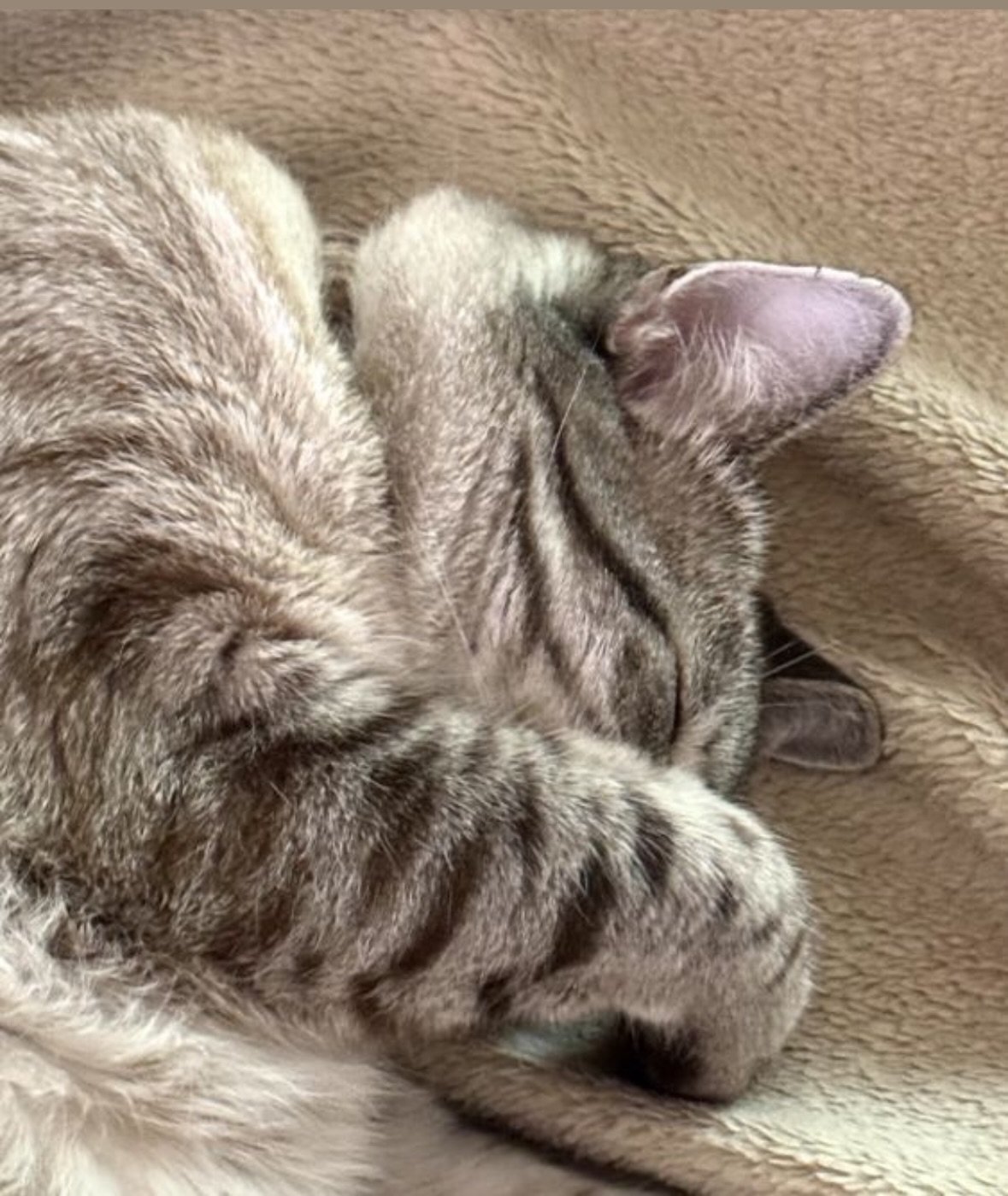
Sleepy kitty
Mackerel tabbies have striped rings around their tails and legs, and a V shape on their chests, with bands of solid or broken stripes running down the sides of their bodies. There are two lines of darker spots their tummies.
Willowe’s an example of a mackerel tabby cat, but she’s not just brown - there’s some silver hair in her coat, too.
I adopted Willowe from Felines and Friends in Santa Fe, New Mexico. They called her a “silver tabby.”
The classic tabby, also known as blotched tabby, has the 'M' pattern on the forehead but, rather than primarily thin stripes or spots, the body markings are thick curving bands in whorls or a swirled pattern, with a distinctive mark on each side of the body resembling a bullseye.
According to Wikipedia, the ticked tabby pattern has a a salt-and-pepper appearance with almost no apparent stripes or bands. Residual ghost striping may be seen on the lower legs, face, and belly and sometimes at the tail tip. Of course, there’s the standard 'M' and a long dark line running along the spine. The spotted tabby is thought to be a genetic variation.
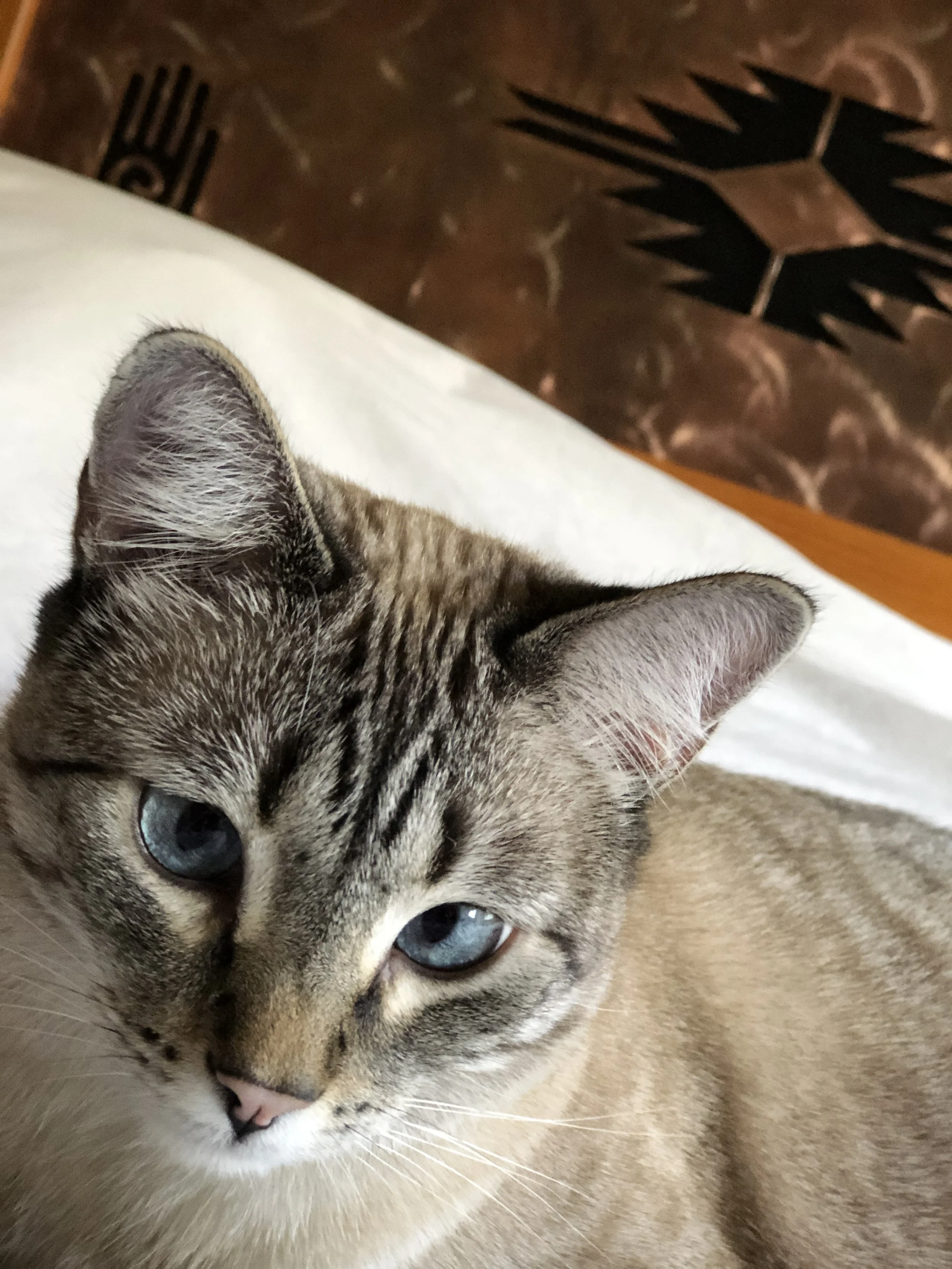
The “M” on Willowe’s Forehead
Here’s some information I’ve gathered about cats in general:
Our domestic cats are members of the Felidae.
We’re all familiar with the whiskers on a cat’s face. I never knew that they have dozens of movable whiskers all over their bodies. Whiskers provide cats with such information as the location of objects in the dark or the width of gaps they want to go through.
You can tell a lot about a cat’s mood from their body language. A cat’s body language includes the position of ears and tail and also whether the cat’s body is relaxed or not. A raised tail indicates a friendly greeting. Laid back ears mean a hostile animal.
Cats have well-developed memories. According to Wikipedia a cat can retain experiences for a number of years and, just like humans, these memories can be associated with emotions.
Cats learn from observation. They can be good at problem solving, too. I’m hoping to get Willowe to use her problem solving skills to help me solve mystery clues.
Cats learn essential survival skills as kittens by observing their mothers. Adult cats continue to learn by trial and error. I never trained any of my cats to do anything, but mine have been good at training me!
My cats have all preferred to play with small furry toys. My house is filled with tiny felt mice and little fuzzy balls.
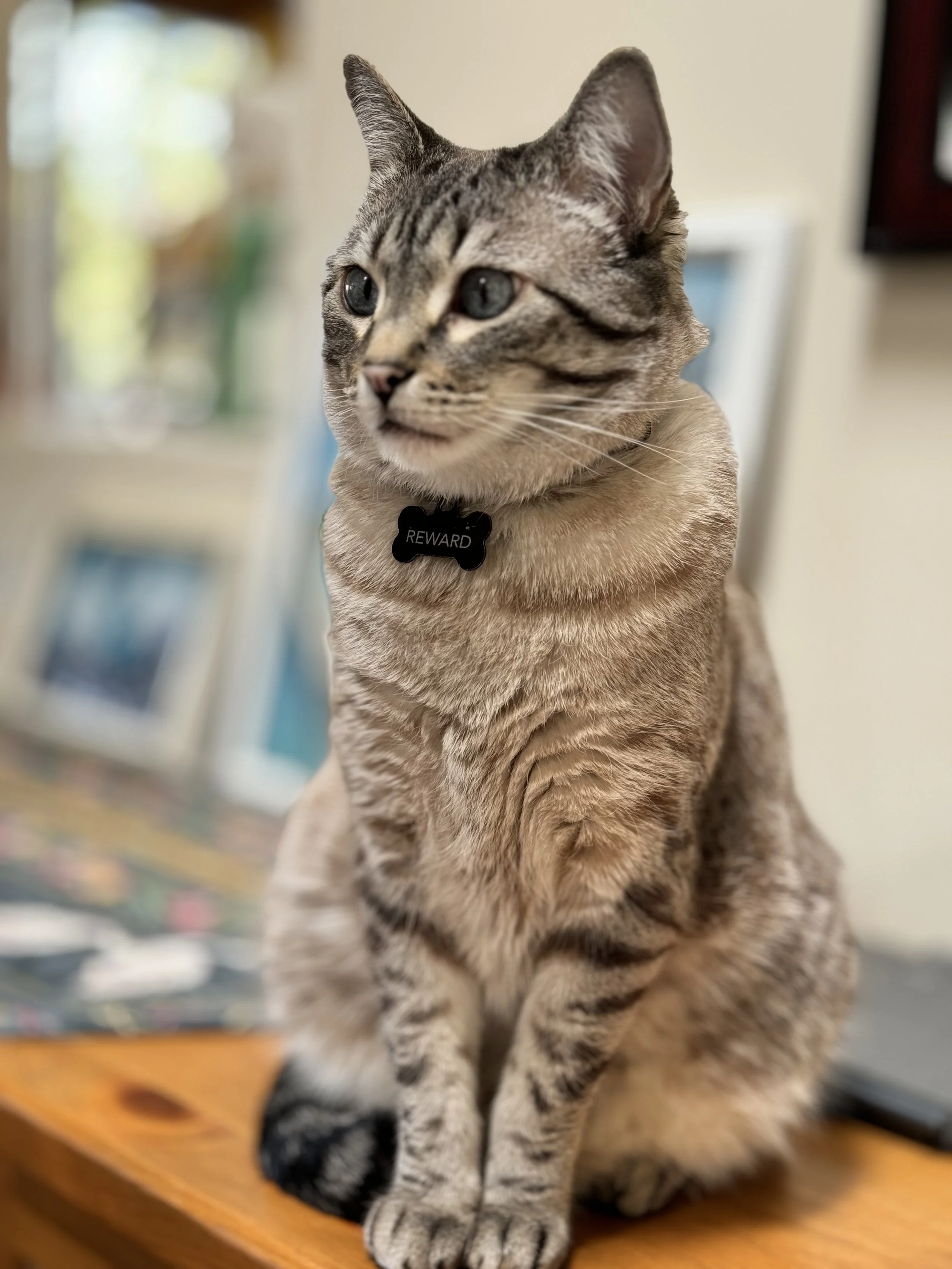
Willowe the Cat - posing for her photo